
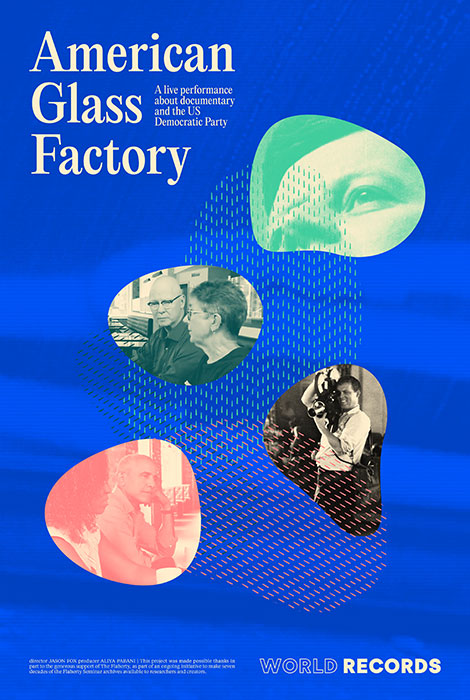
American Glass Factory, the live documentary by Jason Fox, follows the idea of politicians being interested in film, more specifically, the Democratic Party’s involvement and interest in direct cinema and observational documentaries. This idea emerged in Jason Fox’s mind after finding out that Michelle and Barack Obama were both executive producers on the Oscar winning documentary American Factory from 2019. This led Fox to explore the history of democrats and political figures immersing themselves in the world of film, going all the way back to the 1960s with John F. Kennedy and his political campaign against Hubert Humphrey. As a purely observational approach to documenting JFK’s campaign, Fox explores how much of an impact this documentary had on not only the voters but society itself. It gave U.S citizens a lens into a political figure: you were able to go “behind the scenes” with someone who could be the next leader of the country.
Fox compares this observational approach of a campaign to other forms of film coming out around the same time, like the Beatles arriving in the United States for the first time. Another example that Jason Fox presents in his live documentary is the use of the documentary The War Room in the 1990s ahead of Bill Clinton’s campaign for president. Just like the JFK observational documentary, The War Room explores the behind the scenes aspects of a campaign. However, this documentary focuses heavily on the people who helped Bill Clinton win the election rather than Bill Clinton himself. Again, Fox heavily stresses the impact that film has had on politics. Fox then leads us to a familiar space, mentioning the Obamas again. However, this time, the correlation between the Obamas and documentaries doesn’t feel foreign, it feels like a natural occurrence.
When looking at Jason Fox’s live documentary with a critical lens, we need to address a few aspects. First, we need to address what the creators were trying to do. Next, how well did they do it? Finally, was it worth it? Beginning with the first aspect, I think that Fox was trying to do two things. First, I think he was trying to create a unique, never-before-seen type of documentary, channeled through his use of a live documentary approach. Secondly, I think Fox was trying to make audiences take a deeper look into the effects of film on politics.
Having established the baseline for our analysis with the initial question, we can now evaluate Jason Fox’s performance. In terms of creating a unique documentary, Fox excelled. His work was not only critically engaging but also unlike anything I have ever seen. He skillfully utilized a remarkable array of sound and visual cues, making his documentary truly one-of-a-kind. I believe Fox aimed to make audiences delve deeper into the effects of film on politics, and he successfully achieved this. Prior to the live documentary viewing, I had no care or thought about how films and documentaries affected politics and political campaigns. However, ever since the presentation ended, I have been seeing more and more connections between film and politics in my everyday life, which I find astounding. Due to this I can firmly say that I think Fox did a great job in addressing an issue he has seen.
Prior to the live documentary viewing, I had no care or thought about how films and documentaries affected politics and political campaigns. However, ever since the presentation ended, I have been seeing more and more connections between film and politics in my everyday life.
The final question of criticism: is it worth it? Was this live performance worth mine and others valuable time? In all honesty, I would say it was completely worth it. Prior to the presentation, I would see big politicians attaching their name to films and I would always question it. But now with the knowledge I’ve gained from watching American Glass Factory, I can clearly see why that is as well as see how linked politics and cinema are. Film is a powerful medium, and when paired with politics it has the potential to profoundly influence public opinion and shape political outcomes. I would like to say that Jason Fox truly opened up my eyes to a mix of a film and political environment that I rarely ever took notice of, and due to that I would say that this performance was well worth it.
About the author:
Jaxon Moore, a second-year BFA in Film student at the University of Windsor, loves diving into any kind of art, whether painting on a canvas or framing a shot behind a camera. Being on set feels like home; it’s where he can really let his creativity loose. Photography is another passion of his—he enjoys capturing moments and telling stories through his lens. Every project is a new adventure, a chance to explore and grow his skills in visual storytelling as well as a way to make lasting friendships and memories. On top of art, he loves to play sports and to be involved in his school community.
 FAHSS Critics
Leave a comment